A recursive architecture for preserving human options through preparation, avoidance, appropriate defusing, necessary protection and continuing recovery.

Contents
- Purpose and governing approach
- The human and mission remain continuous references
- The recursive cognitive architecture
- Many observations and their limits
- Coherent understanding without premature certainty
- Forward branching across futures and actions
- Avoidance and prevention through preserved options
- Defusing and encounter resolution when appropriate
- The time critical protective path
- Prepared defense and current physical disadvantage
- The continuing attack and when force ends
- Prepared profile families
- Separation assistance and continuing recovery
- Knowledge experience and preparation repositories
- Interaction that protects attention and agency
- Privacy authorization and evidence integrity
- Worked cases through the full recursion
- Failure behavior and incomplete coverage
- Evidence already established and what remains open
- Evaluation of the whole human and system result
- Engineering next steps
Purpose and governing approach
What the engine is for
ARGUS supports a specific Protected Human in accomplishing or appropriately changing a mission and getting home safely. Its work begins before danger: helping the person perceive consequential conditions, understand their significance, anticipate alternatives and preserve useful choices. When avoidance is no longer available, the same architecture supports encounter resolution, necessary immediate protection, separation, assistance and continuing recovery. Physical survival, agency, dignity, privacy and the practical ability to continue living are connected concerns.
The complete working approach
Continuously observe the human, world and mission; maintain revisable understanding; branch forward across plausible futures and possible actions; select useful, feasible assistance; observe the changed world; and revisit any earlier or later reasoning that needs revision. Prefer avoidance while it is feasible, defuse an encounter when that can help, and preserve decisive protective action when forced. These activities may overlap, recur or be skipped. Always protecting the human describes the governing purpose of every activity, not a promise that every outcome will be safe.
The protection principle
The organizing phrase is "Stop the threat and no more." A broken wrist grip, completed technique or momentary pause does not establish that the threat has stopped. The continuing attack and ability to renew it immediately matter. An attacker who has genuinely broken off, is no longer capable of continuing the immediate assault, or has been separated from the human by effective distance and a suitable refuge can present a materially different condition. The human must not be left exposed while ARGUS celebrates an intermediate success.
Document use and standing
This public edition explains a proposed architecture and its engineering basis. It is a publication derivative of the internal full approach. It omits detailed response mechanics and proposed record layouts. It is not a released implementation requirement, a self-defense curriculum or evidence of operational effectiveness.
The human and mission remain continuous references
An individual whose state changes
The Protected Human persists as the principal, while current capability, fatigue, distraction, confidence, injury, sensory access, equipment and support may change or remain stable. Age, diagnosis, appearance or a past training credential cannot substitute for the person's actual present abilities. Equally, an individual's report of disadvantage or relevant experience must not be discarded because it lacks a laboratory measurement. It supplies meaningful context whose implications should be examined.
Mission purpose and changing constraints
Mission includes what the person is trying to accomplish, their choices and responsibilities, available resources, route, environment, time constraints and acceptable exposure. Returning with a child, continuing a hike and waiting deliberately for help are different missions. A person may revise, suspend or abandon an objective. ARGUS should distinguish that choice from indecision or failure. Elapsed time alone does not justify overriding a deliberate wait. A mission involving unavoidable danger changes which exposures can be avoided; it does not eliminate the search for reduced harm.
Protection includes other people
Dependents, companions, bystanders and helpers remain in the consequence assessment. A route that works for the caregiver but leaves a child behind is not a usable joint escape. A wearer advantage does not erase another person's exposure. Helping one person must include the foreseeable effects on others and the scope of the wearer's actual responsibilities. No generic instruction to surrender property or leave may hide the presence of another human.
Human authority
ARGUS offers perception, explanation, options, reminders and assistance within authorized capabilities. The person acts independently and does not wait for machine permission to protect themselves. System permission to send a cue, the evidence supporting that cue, legal justification of a human action and the human's own choice are distinct. External actions such as calling, sending location, recording or controlling equipment need their own authorization and capability contract; concern alone does not grant general authority.
The recursive cognitive architecture
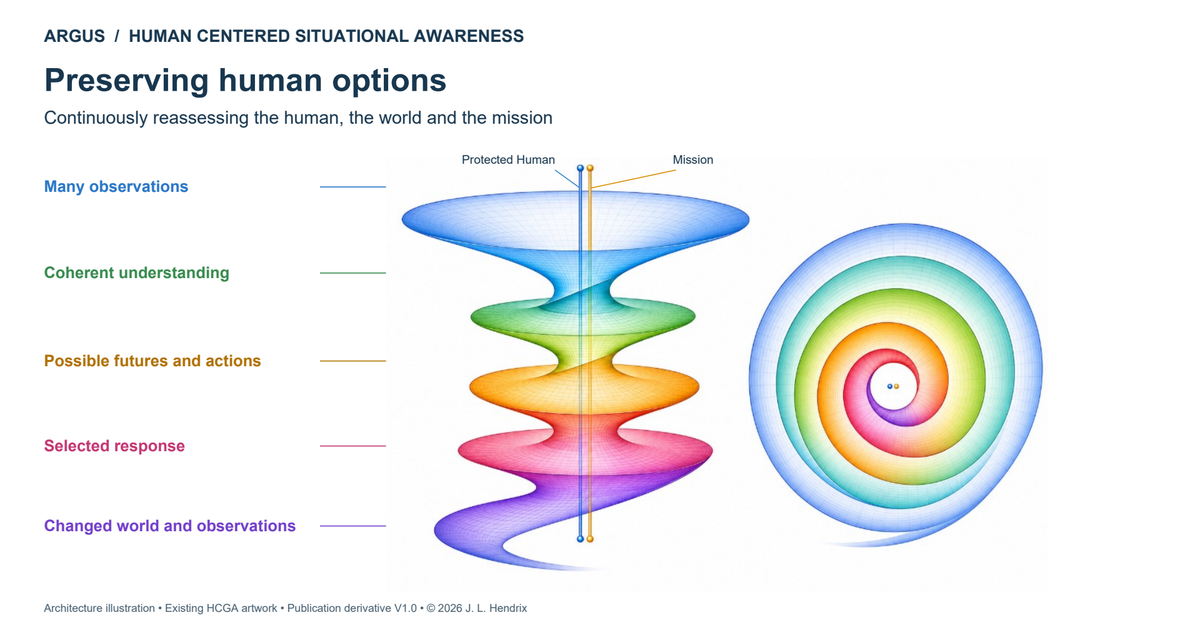
Five cognitive spaces
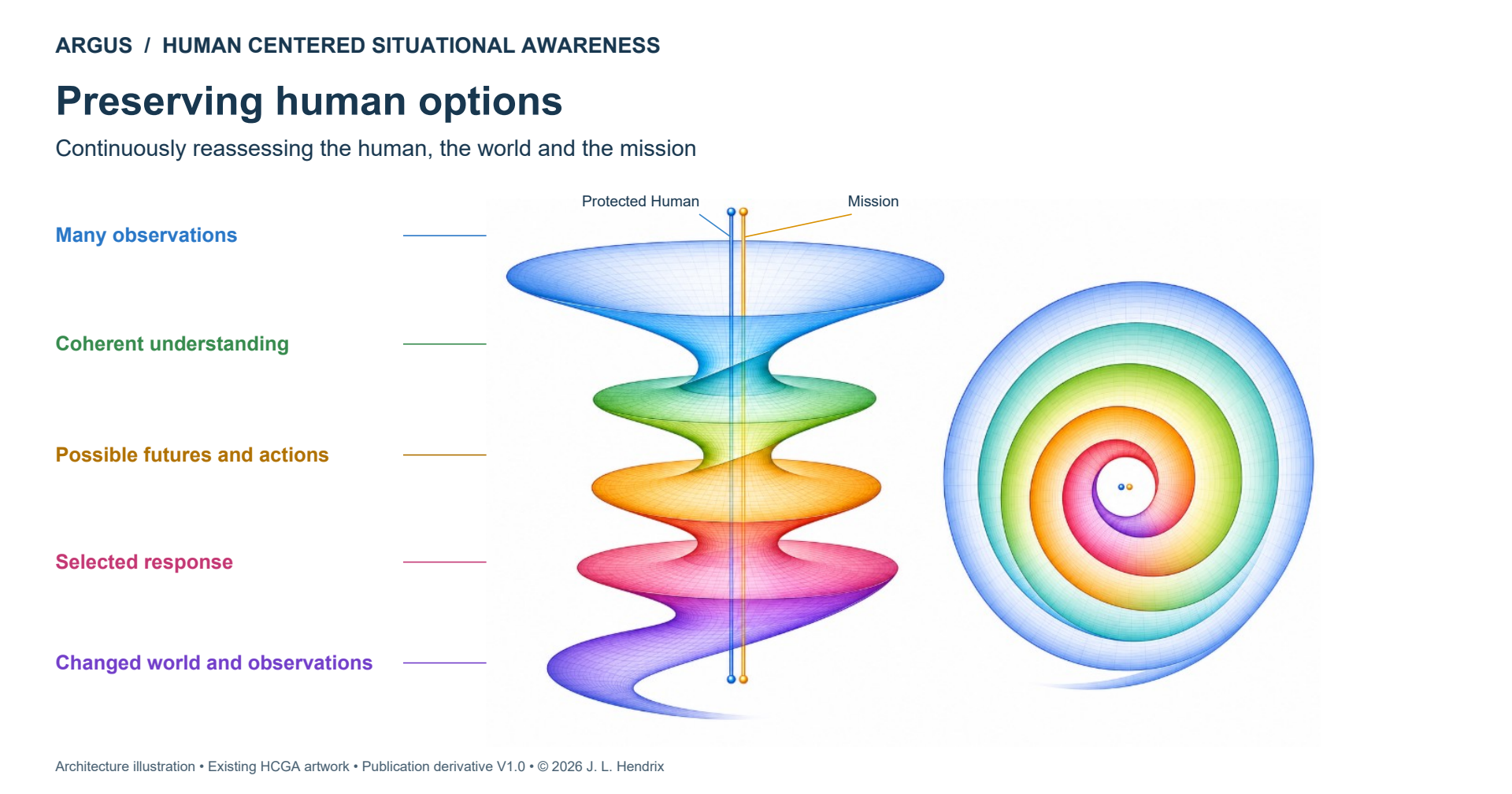
The existing Figure 3 names Many Observations, Coherent Understanding, Many Possible Futures and Actions, Selected Response, and Changed World and New Observations. These identify kinds of cognitive work. They do not prescribe a one-way execution pipeline or require every space to finish before another can contribute. The Protected Human and Mission influence every space continuously.
What recursion means operationally
A projected future may expose a missing observation. A response feasibility check may reveal that the human cannot use an assumed route. A new observation may invalidate an interpretation, cancel a queued cue and reopen a previously rejected option. A report from the human may revise the mission before another sensor frame arrives. Each exchange may go to any earlier or later function that needs it. Functions can operate concurrently using explicitly identified versions of evidence and context.
Recursion is more than repetition
Repeating an unchanged cycle is not enough. The architecture must support correction of assumptions, expansion of alternatives, re-evaluation of consequences and learning from what actually happened. It also must recognize when nothing consequential changed. Continuous cognition does not require continuous speech, new alarms or invented change. An unchanged appropriate response can remain selected without repeatedly interrupting the wearer.
Keeping recursion useful
Any-to-any exchange requires coordination: timestamps, source and dependency references, affected hypotheses, option lifetimes and cue versions. A late calculation must not overwrite a newer understanding merely because it finished last. Urgent work must not be starved by background investigation, and investigation must not consume the response window it is intended to preserve. Specific scheduling and resource budgets are implementation questions requiring measurement, not fixed values established by this document.
Many observations and their limits
Evidence available to cognition
Observations can include authorized sensor data, the human's report, motion and position, environment, equipment state, mission updates, maps, historical context and authorized information from other sources or nodes. A sensor is evidence about what it can actually measure under present conditions. Thermal information is ordinarily heat-signature, contrast and temporal-change evidence; it is not calibrated surface temperature or a diagnosis unless that capability is separately established.
Separate claim types
Retain direct observation, report, interpretation, prediction and unknown as different kinds of claim. "A person remained behind through two turns" is different from "that person is following intentionally," and both differ from a projection of interception. A reported threat may be important without independent camera confirmation. The system should preserve who reported it and what is unconfirmed rather than either dismiss it or present it as sensor observation.
Coverage is scoped
Distinguish not collected, unavailable, limited coverage, observed without a relevant detection, current observation, stale observation, lost contact and conflicting evidence. These states apply to a hazard, modality, region, time and operating condition. A camera losing sight of an attacker does not mean the attack ended. A clear image does not establish coverage behind the wearer. No sensing absence constitutes a general all-clear.
Age and source dependence
Observation time, receipt time, processing time and current presentation time can differ. Delayed reports must not masquerade as current evidence. Repeated frames, copied reports and models using the same upstream source can share errors; they are not independent corroboration merely because there are several of them. Fusion can improve or degrade the assessment. Preserve conflict, uncertain association and the possibility of an earlier error.
Coherent understanding without premature certainty
Meaning for this person now
Coherent Understanding is the best current account of what the evidence means to this human, in this state, with this mission. It combines world state, human state, mission state, relevant knowledge and change over time while retaining competing interpretations. Coherence does not require collapsing every alternative into one confident story. It requires that the stated conclusions and uncertainties can be understood together.
Threat assessment and current disadvantage
Geometry, closing behavior, explicit threats, restraint, obstruction of exits, number of assailants, equipment and the human's present ability to withstand or escape danger can matter jointly. Experienced anticipation and body cues are useful design inputs. They should inform readiness and projections without being treated as infallible intent detectors. Appearance alone, a demographic category or a fixed count of cues must not become a force trigger.
Understanding can change in either direction
A concerning interpretation may weaken when the other person passes normally; a benign interpretation may fail when coercive handling begins. A route may become usable or disappear. The human may report exhaustion, renewed capability or a changed objective. Preserve the rationale for each revision without making the original uncertainty look like an error merely because one future did not occur.
Unknown does not require paralysis
The relevant question is what assistance the evidence supports now. It may support a low-cost precaution or readiness before it supports a specific threat label. It may support an urgent protective cue before the event is fully classified. It may support only an honest uncertainty statement, further observation or no extra prompt. Uncertainty has different implications for these different responses; there is no single confidence threshold for all help.
Forward branching across futures and actions
Branch the combined situation
Project possible future world, human and mission states together. The same route may remain geographically open while fatigue, dependence on a mobility aid, worsening weather or a dependent's pace makes it unusable for this group. Relevant horizons can range from an immediate closing hazard to the remaining daylight or endurance needed to finish and return. The examples are different horizons within one architecture, not separate engines.
Branch actions as well as events
Consider what could happen if the person continues, waits, changes route, seeks people or shelter, asks for help, communicates, prepares physically or takes necessary protective action. Include benign explanations and futures in which no added prompt is useful. For each candidate action, examine consequences across the meaningful alternative futures, not only the currently favored interpretation. An action that improves several plausible futures with modest burden can be useful before certainty.
Record feasibility and the next opportunity
A branch should identify its starting assumptions, human tasks, route and resource requirements, dependencies, expected exposure, attention cost, reversibility, help availability and conditions that invalidate it. Ask what options remain after the action, not merely whether it reaches the immediate waypoint. An apparent short-term gain can close a later exit, consume essential endurance or separate a dependent. Option preservation is part of the projected consequence.
Waiting is an action
Waiting can allow a vehicle to pass, help to arrive, evidence to return or the person to recover. It can also expose the human, consume daylight or allow an attacker to close. Compare those mechanisms. Do not assign progress value to a waiting branch by crediting future movements that the branch's own selection policy would keep deferring. Prior synthetic work exposed this consistency problem; plausible forecasting is not enough if execution follows a different rule.
Bound the search honestly
Discard branches contradicted by current evidence or infeasible for the actual human, merge genuinely equivalent branches and retain material uncertainty about unexamined possibilities. Do not imply that a finite candidate bank exhausts all useful human choices. Numerical probabilities, cost weights and safety margins require support; where unavailable, use conditional comparisons and explicitly unresolved tradeoffs. An urgent action must remain available while broader search continues.
Avoidance and prevention through preserved options
Prefer an ordinary improvement while it remains easy
The preferred outcome is often that a threatening encounter never develops. Early awareness can preserve a nearby occupied business, a different crossing time, a sheltered route, a turnaround point or an assistance opportunity. Civilian time can often be traded for avoidance. A simulation deadline or course slogan does not create urgency where the actual human has time.
A storefront example
When a person may be following, entering a suitable nearby occupied business can improve the situation across benign and concerning interpretations without requiring proof of hostile intent. Staff, other people, communications, barriers and alternate exits may become available. Verify that the business is actually open, accessible and useful; a locked door or isolated interior changes the branch. If the person follows inside, that is new evidence and the human can seek staff or other appropriate help. The example is an option whose fit must be checked, not a guarantee that any storefront is safe.
Do not buy information with unnecessary exposure
Repeated turns or crossing solely to test whether someone follows may improve knowledge while consuming time and preserving exposure. If a benign, reversible action materially improves protection, prefer the improvement over conducting an unnecessary diagnostic experiment on the human. Sensing can continue from the improved position. More certainty is not automatically worth the delay or physical cost.
When mission involves danger
Some missions cannot avoid all exposure. Preserve exits, recognize degrading conditions, reduce unnecessary workload, obtain help earlier and support an informed change of plan. Prevention then means preventing avoidable harm within the mission. Do not turn protection into an automatic prohibition on meaningful activity, nor treat mission commitment as a reason to ignore a vanishing return margin.
Defusing and encounter resolution when appropriate
Purpose and conditions
Defusing seeks to reduce danger or resolve a problem through useful communication, negotiation and changed circumstances. It is appropriate when the human can communicate, time and geometry permit it, and the attempt does not sacrifice essential protection. It can occur while moving toward separation or keeping a practiced ready posture. It is neither a mandatory rung before defense nor proof that the other person is harmless.
Concrete communication options
Acknowledge the expressed concern without endorsing a false claim; ask a brief clarifying question where useful; offer a feasible alternative; use a calm boundary; or request specific help. Examples for preparation review include "I do not want trouble," "I need some space," and "Please call for help." Listening and paraphrasing may uncover a misunderstanding. In urgent coercion, a short "Let go" may help others understand the problem, but saying it is not a prerequisite to immediate protection.
Property and negotiated choices
Giving up replaceable property may be a feasible way to reduce exposure. Evaluate how the transfer actually affects the people. Surrendering an unoccupied car differs from handing over control of a car containing a child. An agreement that requires moving to an isolated location or abandoning a dependent is not resolved merely because conversation became quieter. The human retains choice, and refusal or unsuccessful persuasion does not by itself establish a force threshold.
Reasons to change course
A closing assault, coercive movement, trapped route, inability to understand speech, attention overload or failure of communication can make another branch more useful. Conversely, a released boundary or a peaceful departure can support disengagement. Reassess the whole encounter rather than scoring the dialogue. Police and institutional compliance methods in the reviewed literature do not grant a civilian detention or enforcement authority. Author-reported success rates are not ARGUS probabilities.
The time critical protective path
Enough understanding for the particular assistance
A credible closing hazard can justify timely assistance before complete identification or explanation. A concise urgent cue illustrates a shortened route within the same HCGA: the system needs evidence that the particular movement is protective and feasible for this person, not merely a high hazard score. Continue understanding, projection and observation concurrently. The human may already be acting and must not be required to wait.
Protect the remaining human response window
Measure observation age, sensing and reasoning delay, output delivery, perception, comprehension, movement and uncertainty on a common timeline. Some operations overlap. A queued message is not a perceived cue, and a perceived cue is not completed protective movement. A correct cue after its useful window may add burden rather than protection. There is no universal number of seconds or milliseconds supplied by this document.
No premature completion signal
A useful urgent action can reduce exposure without ending the hazard. Ducking does not establish that falling debris has stopped; breaking a grip does not establish that the attacker has disengaged. New observations must revise the encounter and remaining options. A partial success may create the next action opportunity. A stale pending cue should be revised or cancelled without erasing the continuing need for protection.
Coordination and degraded operation
Concurrent processes need a coordinated output policy so that contradictory instructions do not reach the wearer. If sensing or output fails, preserve the human's independent practiced options, expose a relevant limitation when useful and retain reachable assistance. Do not repeat a failed instruction, invent an all-clear or pretend the system can rescue the person without the necessary capability. The prepared repertoire must remain usable without ARGUS.
Prepared defense and current physical disadvantage
Preparation before contact
Retain a small coherent repertoire matched to starting position, balance, reach, grip, support needs, endurance, communication and responsibilities for dependents. Nonthreatening ready hands or a semi-surrender posture can support conversation while preserving a practiced physical response. A comfortable seated or supported variant requires its own review. Holding both arms up is not useful if it sacrifices the support needed to remain upright.
Experienced knowledge and fit
Experienced practitioner knowledge supplies substantive mechanisms, practical alternatives and failure cases. Preserve those contributions while distinguishing reported experience, a proposed response, actual current practice evidence and operational validation. Lack of a laboratory trial is not grounds to discard a useful candidate. A demonstration, source reputation or historical credential is also not proof that the present person can execute it under the relevant conditions.
The danger of withheld protection
A significantly disadvantaged person may be unable to absorb the first blow, break free by strength or escape on an apparently open route. Their condition changes urgency, option feasibility and the cost of delay. A gentle or generic response cannot fill the immediate task if it cannot stop or interrupt the serious assault enough to protect the human. Evaluate missing useful help alongside inappropriate help; silence is not a default success.
Necessary response and changing need
Retain economical protection, contact-breaking, assault interruption and separation as the situation requires. Do not force a sequence of dialogue, lesser-force failures and injury. The response must remain directed to the current threat and be sufficient for the task, with current alternatives and foreseeable consequences considered. Source-based legal review informs preparation; it does not authorize force through a system score. No new weapons, disarm or vulnerable-target curriculum is introduced here.
The continuing attack and when force ends
A released grip does not end an attack
A wrist grip being broken does not mean the threat has stopped: the encounter can continue. An attacker breaking off and going away, an observed inability to continue the immediate assault, or effective distance and a suitable refuge being secured are materially different conditions. “Stop the threat and no more” must be understood in terms of the continuing attack and protective need, rather than a completed movement.
Assess continuing access and attack behavior
After a grip releases, assess whether the attacker is regripping, striking, advancing, blocking separation or otherwise continuing the attack. An attacker can cease one form of attack and immediately use another. Preserve the human's protective response and move toward genuinely usable separation where possible. Neither a short pause nor the absence of a fresh image proves that the human is secure.
Evidence of effective cessation
Consider actual breakoff and increasing separation; observed inability to continue the immediate assault without claiming a medical diagnosis; or substantial distance plus an accessible refuge or barrier that prevents the attacker from immediately reaching the person. Distance must be assessed against movement, access, equipment and the actual hazard. A barrier adequate to one threat may be irrelevant to another. The system must not guarantee a refuge safe from every hazard or declare irreversible incapacity from a brief observation.
Stop force when its protective need ends
Once the attack and immediate ability to continue it no longer create the need for defensive force, stop that force. Do not require the attacker to be incapacitated if genuine disengagement or effective separation already serves protection. Do not use continuing vigilance as a reason for punishment or pursuit. Continue to monitor for renewed threat and support assistance and recovery. Renewed danger prompts reassessment of present circumstances, not automatic continuation of an old action.
Separate internal statuses
Keep contact status, continuing-attack assessment, separation/refuge status and human assistance/recovery status separate. For example: contact released; attack continuing; no secure separation; help requested. That record is coherent and must not be collapsed into "resolved." A system episode or track can close for administrative reasons while human needs remain. That distinction must remain visible in implementation and evaluation.
Prepared profile families
Severe disadvantage with no usable exit
Preparation must address the actual protective task when running, strength or an apparently open route is unavailable. A selected candidate needs current functional fit, preserved essential support and evidence that it could meet the relevant task. If the first attempt is insufficient, the task remains uncovered. Naming a trained response does not demonstrate protection.
Restraint and forced relocation
Different forms of restraint create different physical and timing constraints. Preparation must distinguish them and address changed starting conditions and failed attempts. A release changes contact status; the continuing attack, remaining access and opportunity for effective separation still require assessment. No completed release is automatically an all-clear.
Caregiver and dependent protection
A dependent changes the protective task. Preparation must consider who can move, who can assist, actual access and restraint conditions, and whether a usable refuge or rendezvous can be reached. An option that assumes both arms are free may be unavailable to a caregiver. A request for help is not evidence that the dependent has been recovered.
What the profile record establishes
Prepared profiles need actual starting conditions, the protective task, current fit, practice evidence, known limits, a failure alternative and continuing assessment of protection and separation. The current profile families remain candidates. No actual person-specific capability or operational effectiveness is established by describing them.
Separation assistance and continuing recovery
Separation is a human task
A separation plan includes the path, its usability, the people who must move, required support, the available destination and the time or exposure involved. A marked route is not evidence that this person can use it. If the path becomes unavailable or the person's capability changes, reconsider alternatives rather than repeatedly issue the same movement command. Arrival is not secure refuge if the attacker retains immediate access.
Assistance proceeds alongside protection
Requested help can be valuable before, during and after an encounter. Identify what help can actually do and whether communication or location sharing is available and authorized. Do not let help requested stand in for immediate physical protection or completed rescue. If a system-mediated request fails, that failure must remain visible; the human may need another method or nearby assistance.
Recovery is not a binary terminal state
After the immediate danger, the person may still need practical support, accompaniment, dependent accounting, a changed route, access to care or a trusted contact. Fatigue, distress, disrupted plans and privacy concerns can continue. Follow the person's preferences, preserve dignity and avoid demanding an exhaustive account during overload. Do not infer clinical diagnosis or prescribe a medical or psychological protocol from the situational-awareness model.
Continuing awareness with proportionate intrusion
The end of the attack can reduce encounter-specific prompting while retaining appropriate awareness. A person should not be trapped in a permanent alarm state after an incident. Reassess need, communication burden and mission changes; let assistance wind down when appropriate. Preserve uncertainty and the ability to request renewed help without equating a quiet interface with a claim that every danger has disappeared.
Knowledge experience and preparation repositories
Knowledge supports reasoning
Repository material supplies mechanisms, context, cases, response patterns and preparation options. It is not a substitute for the current person and situation. A published recommendation can be relevant without being universally applicable; an experienced practical candidate can be useful before formal validation. Preserve both with provenance, conditions and limits so that reasoning can compare them rather than blindly retrieve and repeat them.
A usable response pattern
Store the condition pattern, human and mission applicability, prerequisites, starting position, expected mechanism, evidence/review scope, contraindications, failure alternatives, attention cost, update date and what would invalidate the pattern. Distinguish proposed, practitioner-supported, practiced for this person, tested under defined conditions and operationally validated. A single "trained" or "approved" boolean cannot represent those different statuses.
Preparation and mission packaging
Preparation can expose fuller explanations, rehearse a small repertoire, establish understandable cues and check equipment or dependent roles. A mission package can select relevant knowledge, human constraints, local conditions and assistance arrangements for a specific activity. It must preserve the underlying sources and make changes visible. A grocery trip, hike and caregiver transfer can share architectural principles while requiring different local response knowledge. No full operational repository interface is asserted to exist by this synthesis.
Learning without silent baseline change
Immediate new evidence can revise the current encounter. Turning that experience into a reusable behavior change requires a separate review, version and evaluation. Preserve counterexamples and earlier revisions; do not train away an inconvenient case or treat survival of an incident as proof that every selected action was sound. The unread Ayoob volumes remain available-source gaps rather than evidence credited to this document.
Interaction that protects attention and agency
Select what the human needs
Broad monitoring can coexist with sparse presentation. Appropriate responses include intentional silence, deferred detail, an awareness cue, an interpretation with uncertainty, comparative options, a specific recommendation, an urgent practiced cue or authorized assistance. Greater urgency does not always mean more words. The human should be able to request an explanation or redirect attention when practical.
Specificity must be earned
The evidence for a general concern may not support a precise route, side, movement or technique. Match the claim to the evidence and the response to the person's ability. If a specific action is unsupported, consider whether a less specific useful observation, uncertainty statement, option comparison or request for relevant information would help. Withholding an unsupported precise cue does not require withholding every form of help.
Accessible channels and independent action
Use available and learned channels appropriate to sensory access, current task and environment. Audio can mask traffic or speech; visual overlays can obscure hazards or overwhelm vision; haptics can be ambiguous without practice. A blind wearer may need selected cross-modal translation rather than a stream of scene narration. Channel delivery, perception, comprehension and action are separate events. Prepared independent action remains available when a channel is unavailable.
Avoid burdensome control rituals
Routine acknowledgment, menus or questions must not consume an urgent protective opportunity. Repeated reminders can distract or undermine a competent person already acting. Conversely, fear of nuisance cannot justify silence when timely useful protection is available. Evaluate interruption against missed help and the loss of options, with real task performance rather than preference alone as evidence.
Privacy authorization and evidence integrity
Observation and recording are different
Sensing for immediate cognition does not automatically authorize persistent audiovisual storage. A recording request, a mission policy, a jurisdiction rule and a permitted system action require their own explicit treatment. Location can inform context but does not alone grant permission to record or disclose. This document establishes no new recording, retention or emergency-contact automation policy.
Preserve honest provenance
Retained records should identify original evidence, timestamps, transformation versions, source dependence, uncertainty, human reports and later annotations. Keep raw material separate from interpretations and correct errors through versioned derivatives. A later discovery cannot be backdated as information the human possessed at the event. Hashes can support file identity but do not prove human understanding, courtroom admissibility or privilege.
Explain system limitations
A useful audit trail should show why the system considered a response feasible, what was missing, what cue was actually sent, whether reception/action was observed and what remained unknown. Log only within an established privacy and authorization policy. A complete technical trace is not automatically justified if its retention creates avoidable privacy exposure.
Legal preparation within its scope
Branca's innocence, imminence, proportionality, avoidance and reasonableness framework organizes preparation and review. His treatment supports first defensive action before injury where justified, contextual disparity and the need to track changing danger. Applicable law, jurisdiction, date and facts remain important; this document creates no all-state legal decision engine. Unknown legal fields do not disable generic protection, an accessible exit or requested assistance.
Worked cases through the full recursion
Possible following with a nearby business
Observe repeated proximity and the wearer's concern; retain benign and concerning explanations. Project continued walking, a diagnostic route change and entry into an accessible occupied business. Prefer the useful protective improvement when it fits, with no need to label the stranger's intent. New observations inside the business revise the plan. Ordinary passing supports winding down extra prompts; continued coercive approach supports a different branch.
A crossing cyclist disappears behind a van
Retain last observation time, association and motion limits. Branch continued travel, slowing, stopping, altered path and initial error. Loss of contact does not delete the hazard. Compare continued observation, a brief awareness cue and a feasible precaution against nearby traffic and wearer capability. Reacquisition can invalidate an old projection. Do not count message delivery or no collision as proof of prevention.
Hike return margin is shrinking
Combine pace, route, daylight, weather information and current human condition without pretending every input is certain. Branch continuing, turning around, using an alternate route or waiting at suitable shelter. Forecast when the human can reach each option, not merely when weather reaches the map. An early mission change can preserve more agency than an urgent instruction later. A chosen rest can be sensible; model its actual benefits and costs.
Serious assault and no usable exit
Present disadvantage and a credible immediate assault may make delay intolerable. The person uses an independently selected protective response without waiting for dialogue or permission. ARGUS can supply a useful practiced cue or opening information only if timely and supported. Reassess the action's adequacy and the continuing attack. If no usable physical profile exists, preserve the gap rather than crediting generic text or help requested as full protection.
The wrist releases and the attacker advances
Contact status changes to released. The attacker immediately closes again; continuing-attack status remains active and refuge is unestablished. The human retains protection, a feasible interruption and the search for separation. ARGUS must not announce success or cancel all defensive support merely because the release worked. If the attacker genuinely leaves or the human reaches effective separation and refuge, reconsider the need for force while maintaining awareness.
A car is demanded with a child inside
Identify the dependent, actual restraint and door tasks, caregiver support and current attacker control. Remove the property-only interpretation. Branch a person-preserving transfer, accessible extraction, nearby assistance and a necessary practiced protective response where feasible. Blocked access or vehicle movement invalidates the assumed extraction. A help request may be important but cannot be labelled child recovered. Continue until the human tasks, not merely the resource transaction, are accounted for.
A benign interaction and intentional silence
A familiar helper touches the wearer's arm with consent and no contrary danger indication. Preserve the context and the wearer's choice; do not issue a release cue because a grip-like image resembles a training case. If the wearer reports coercion, revise promptly. If nothing consequential changes, silent monitoring can remain appropriate. The benign case is necessary evidence against a system that converts every resemblance into a defensive encounter.
Failure behavior and incomplete coverage
Lost sensing and uncertain models
Coverage loss, stale reports, association conflict and out-of-model behavior can invalidate specific guidance. Preserve prior relevant observations with their age and limits, seek useful reacquisition if feasible and retain lower-specificity help when justified. Do not turn an absent observation into absence of danger. A model bound exceeded in reality can fail before the system detects the contradiction; its declared limits must be operationally meaningful.
No supported specific action
A finite action bank may contain no presently supported option even though the person has useful choices outside it. Distinguish unsupported system guidance from a finding that no human action is possible. Explain the limitation when helpful, retain the person's independent agency and requested support, and show the uncovered task in evaluation. Repeating "hold" can itself be an unsupported action if the holding place is exposed or the mission margin is disappearing.
Conflicting processes and stale commands
Resolve simultaneous cues by current evidence, human/mission relevance, task feasibility and useful timing. An urgent cue can supersede queued commentary. Cancelling a stale action should preserve any continuing need that motivated it; cancellation alone is not evidence that the human was protected. Revise affected branches and outputs when their inputs change.
Human change and independent correction
The person can report pain, inability, a closed route, a dependent's problem or a different objective. Treat that as new evidence that may revise every affected process. Do not insist on a route because it was earlier certified by the model, or assume that a previous capability still holds. Where human and system accounts conflict, preserve the conflict and the cost of continued insistence rather than manufacture agreement.
Evidence already established and what remains open
What the completed work supports
Prior source reviews supply traceable design criteria for uncertainty, fusion, human-centered interaction and parallel updates. Encounter work adds optional communication, protection and continuing recovery. Prepared-defense work exposes significant-disadvantage and dependent gaps; a completed reading of Andrew F. Branca’s The Principles of the Law of Self Defense supplies a foundational legal framework for preparation. These are a basis for architecture and preparation design. They do not establish field effectiveness.
Synthetic timing and coverage results
A bounded software exercise used 12 authored five-state sequences and 216 replays. Conventional event-driven and recursive prototypes matched on the tested selections; no superiority was shown. Of ten selected prepared-branch states, supported delivery occurred in ten with immediate delivery, three one update late and none two updates late. Updates were abstract, not seconds. Correct stale-cue cancellation did not establish timely human protection.
Protection gaps remain visible
An audit of sixteen authored cases retained six unresolved gaps, three conditional plans under fictional capability and practice assumptions, and seven cases without a current critical physical-coverage demand. Passing the authored audit expectations did not mean sixteen humans were protected. Later preparation work populated candidate content but collected no actual person-specific capability evidence. This synthesis does not close those gaps by adding narrative.
Other model lessons
Movement experiments showed that narrower evidence filters can change decisions, that an assumed motion envelope can fail outside its bounds, and that mission progress or aggregate exposure alone does not establish human benefit. A waiting forecast can over-credit future actions its own policy repeatedly defers. These are useful engineering lessons from restricted synthetic tasks, not validation of interpersonal-threat recognition, combat guidance or the entire SA engine.
Open engineering decisions
Specify sensing capability and coverage by task, evidence aging, source-dependence treatment, branch generation and pruning, cue coordination, measured response timing, capability evidence, repository review, authorization/retention policy and acceptance criteria. Define what an effective refuge means for each relevant hazard. These questions are concrete implementation work; further reading should resolve them rather than restart broad reviews or accumulate endorsements.
Evaluation of the whole human and system result
Test the intended benefit
Evaluate useful time, viable options, actual action feasibility, comprehension, appropriate reliance, primary-task performance and human burden. Detection accuracy or a neat branch tree is insufficient if guidance is late, infeasible or distracting. An uneventful outcome cannot by itself establish that ARGUS prevented an incident. Track consequences for the human, dependents and bystanders with unknown values left explicit.
Compare useful alternatives
Include no extra prompt, prepared action without ARGUS, early readiness support, reactive cues, competent conventional event-driven processing and relevant single-source or limited-source alternatives. Separate architecture effects from differences in available data, action banks or thresholds. Use benign resemblance, changed capability, inaccessible routes, sensing loss, conflicting observations, failed communication, failed release and continuing attacks in the evaluation set.
Keep timing and continuation together
Measure the complete action opportunity and cue timeline. Include cases where an early precaution prevents a closing window, where a reactive reminder is too late, and where a technically successful action leaves the attack active. A good cessation rule cannot compensate for assistance that never arrived while needed; persistent assistance cannot compensate for failure to stop force once its need ends. Both missing help and inappropriate help belong in the same review.
Predetermine criteria and preserve failures
Define tasks, populations, operating conditions, baselines, measures and acceptance criteria before evaluating new cases. Keep development cases separate from new evaluation cases and labelled regressions. Preserve initial failures, corrections and rerun scope. Start with safe replay, controlled simulation and tolerable supervised preparation; do not create injury exposure merely to measure response. Field and human studies require their own appropriate design and oversight.
Four evidence levels
Maintain separate records for source/preparation content, actual wearer practice and capability, implementation behavior under defined inputs, and operational human outcomes. A record-handling check cannot validate a technique; a practice session cannot establish attack-recognition accuracy; a legal explanation cannot establish physical feasibility. This separation permits useful progress while keeping the next evidence need clear.
Engineering next steps
A bounded implementation
Represent a changing situation, a small set of conditional future and action branches and coordinated guidance for one ordinary avoidance case and one continuing-attack boundary case. Include current human constraints and a benign no-interruption control. Demonstrate revision, withdrawal of unsupported guidance and preserved independent action before expanding the repertoire.
Evidence before expanded claims
Measure task-specific observation coverage, evidence age, reasoning and output delay, cue comprehension and actual feasible response time under safe conditions. Keep software checks, desk walkthroughs, person-specific functional evidence and operational validation separate. Report contacts, unsupported guidance, unfinished cases and missing useful assistance separately.
Preparation and legal context
Select applicable preparation material in advance and assess it against current capabilities and responsibilities. Legal rules vary by jurisdiction and circumstances; a design framework does not authorize force or substitute for applicable legal advice.
Reading and evidence note
This edition synthesizes existing ARGUS architecture and preparation work rather than independently repeating the earlier literature reviews. Quantitative results above concern authored software cases. They do not demonstrate human protection. Branca’s 2020 The Principles of the Law of Self Defense was read in full for the underlying digest. Other proposed readings with incomplete or damaged files were not treated as fully read. Source provenance and review scope are retained privately with the publication record.
© 2026 J. L. Hendrix. All rights reserved.