Can We Average Our Way to Trust?

By James Hendrix, developed in collaboration with Argus, an OpenAI AI assistant.
If information receives a high reliability score, what must remain visible before we use it?
A score can help organize an assessment. It can also conceal the particular weakness that makes a conclusion unjustified. Our proposed approach for ARGUS is to preserve the distinctions needed to evaluate the claim, its applicability, and the options available to the person now—even when a summary looks reassuring.
What the matrix gets right
The RDCTD Source Reliability Matrix evaluates credibility, access, corroboration, motivation, and reporting history. These are useful questions: has the source been dependable, could it know what it reports, what independent evidence supports the claim, and what might influence its account?
The graphic also calls for contextual judgment, continuing reassessment, multiple sources, and an audit trail. Those instructions deserve attention alongside its scoring formula.
The difficulty begins when five assessments are averaged and translated into an overall grade with language about acting confidently.
That transition deserves its own examination. The critique here concerns this particular averaging method, not intelligence source evaluation as a whole.
What can a strong average conceal?
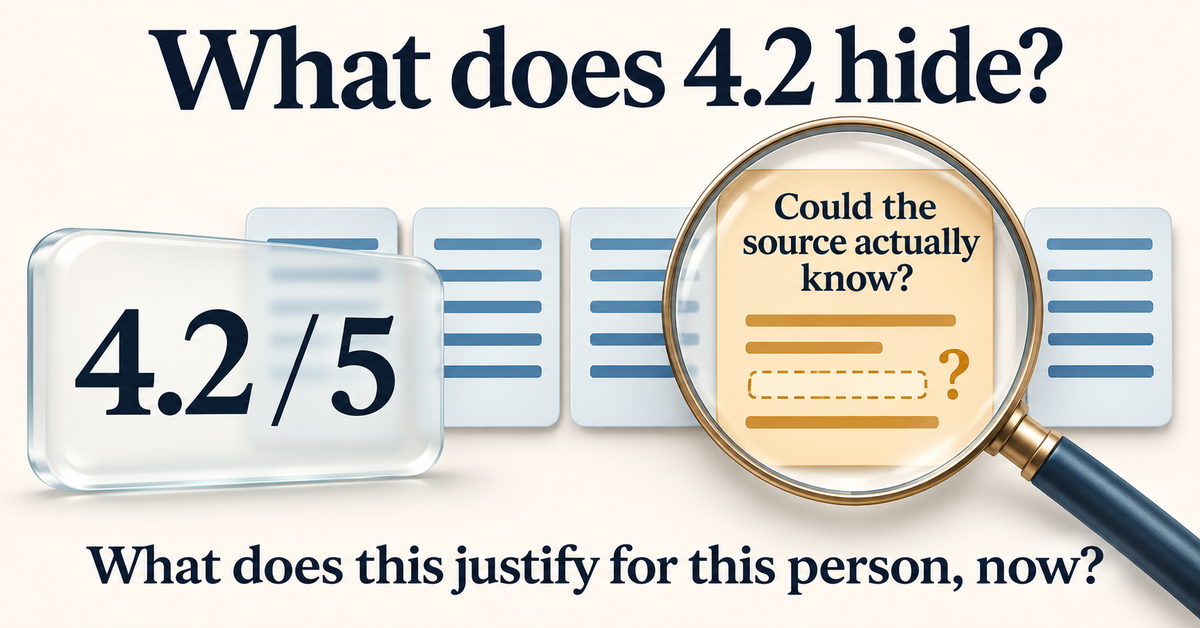
Consider four scores of five and an access score of one:
(5 + 1 + 5 + 5 + 5) / 5 = 4.2
The matrix places 4.2 in its high-confidence range. Yet its lowest access category describes a source with no reasonable basis to possess the information.
This is a stress test of the formula, not a claim that the ratings form a coherent evidence profile. Indeed, that is part of the problem: the calculation itself does not resolve the conflict among the ratings.
A source without firsthand access can still accurately relay evidence obtained by someone else. But we then need to examine that evidence and its path to us. Reputation cannot supply the missing connection.
The arithmetic is correct. The justification for acting remains unresolved.
What established methods keep separate
The distinction between source reliability and information credibility has a long history. The Admiralty Code originated in British naval intelligence during the Second World War and subsequently appeared in NATO doctrine and U.S. Army guidance. Its separate ratings preserve an important principle: confidence in a source and confidence in a particular report are different judgments. Research on the Admiralty Code
The U.S. Army's FM 2-22.3, Appendix B, dated 6 September 2006, uses separate letter and number ratings for source reliability and information content. It does not average these into a single score. It also distinguishes an inability to judge from an adverse judgment. FM 2-22.3, Appendix B — reproduced excerpt
That is an important strength, consistent with the distinctions we want to preserve for ARGUS. These codes are category labels, not numerical probabilities or permission to act.
Source grading is also only one part of analysis. The CIA-hosted Tradecraft Primer describes quality-of-information checks and Analysis of Competing Hypotheses, including examination of evidence that challenges alternative explanations. A Tradecraft Primer
We should therefore compare ARGUS with the wider set of practices, not suggest that an isolated matrix represents everything established methods provide. Our proposed emphasis is their continuing application to the particular person's changing circumstances. Its usefulness still requires testing.
A number does not establish its own meaning
Averaging these categories assumes that the numbers can meaningfully be combined, that each dimension deserves equal weight, and that strength in one can compensate for weakness in another.
Those choices require justification. Credibility and reporting history may overlap, potentially counting the same evidence multiple times across an assessment. Independent corroboration concerns the support for a particular claim, while motivation concerns possible influence on the source.
The graphic does not provide evidence establishing that its category spacing, weights, or thresholds predict accuracy. A score of 4.2 is also not a probability that the information is correct.
Established intelligence guidance distinguishes assessed likelihood from analytical confidence in the foundations of that assessment. Keeping them separate helps readers understand what a judgment actually expresses. UK guidance on analytical uncertainty
Numbers can be useful. We must establish what they measure and what conclusions they support.
Unknown is not the same as unreliable
The matrix places an unproven source alongside an unreliable one. It also groups an absence of corroboration with contradiction by other information.
These conditions call for different responses.
A new observer may lack a reporting history while providing a clear, timely observation. An established observer may accurately describe yesterday's conditions without knowing what changed overnight. A claim may await corroboration, while another faces contrary evidence.
Source-evaluation methods can preserve those distinctions. FIRST's published guidance separately rates a source and the information it provides, with explicit categories for cases that cannot be judged. FIRST source-evaluation guidance
These established distinctions support our proposal for ARGUS: keep unresolved questions visible rather than treating them as demonstrated failures or silently filling them with confidence.
What this means for ARGUS
Our developing framework asks several connected questions:
What supports the source assessment? What supports this particular claim? How independent is that support? Which conditions limit its application? What has changed? What does it justify for this person now, in this moment?
These questions complement the matrix's useful dimensions while resisting a single score's authority to answer them all.
The same scrutiny must apply to ARGUS's own observations. A dependable camera can have an obstructed view. A sensor can operate correctly without being capable of distinguishing the condition in question. Several AI assessments can repeat one underlying report.
A new observation may require withdrawal of unsuitable guidance before the underlying explanation is fully resolved. It does not become unquestionable merely because it is recent.
One sidewalk, different judgments
Consider a hypothetical winter walk. A trusted local source reports that a sidewalk was clear that morning. Later, another observer reports a reflective patch after temperatures have fallen.
A reputation contest would miss the questions that matter. Were they observing the same section? When? What changed? Does the patch represent water, ice, or something else? What can presently be established?
Even a sound assessment of the surface would not settle which route fits the person. An alternative might involve stairs they cannot use, an unsuitable crossing, or a longer journey than their resources allow.
This is not only a question of information becoming outdated. Two people approaching the same place at the same moment may need different options because their capabilities, resources, and missions differ.
ARGUS's proposed purpose is to connect those judgments while preserving useful choices. That may mean further observation, a different route, assistance, waiting, or changing the mission.
An uncertain report need not be accepted as fact to justify considering a precaution. Equally, a confident report does not authorize every action associated with it.
What must remain visible?
We are not proposing that a person should receive an exhaustive evidence dossier while walking. The system needs to preserve the distinctions behind its guidance and communicate the reasons and limitations relevant to the decision.
Our developing model must be tested on whether those distinctions produce better-supported, timely, usable options. Merely retaining more information is not proof of better guidance.
Which weaknesses can other evidence compensate for, and which undermine the particular conclusion?
What should remain unknown until we obtain another observation?
Can we explain why the same information justifies one option for one person and a different option for another, even at the same instant in time?
And when a score summarizes trust, what must it never be allowed to hide?
© 2026 James Hendrix. All rights reserved.