Recognizing danger is only part of protecting a person. The harder questions are what it means to this individual, what may happen next, and which useful choices will remain.

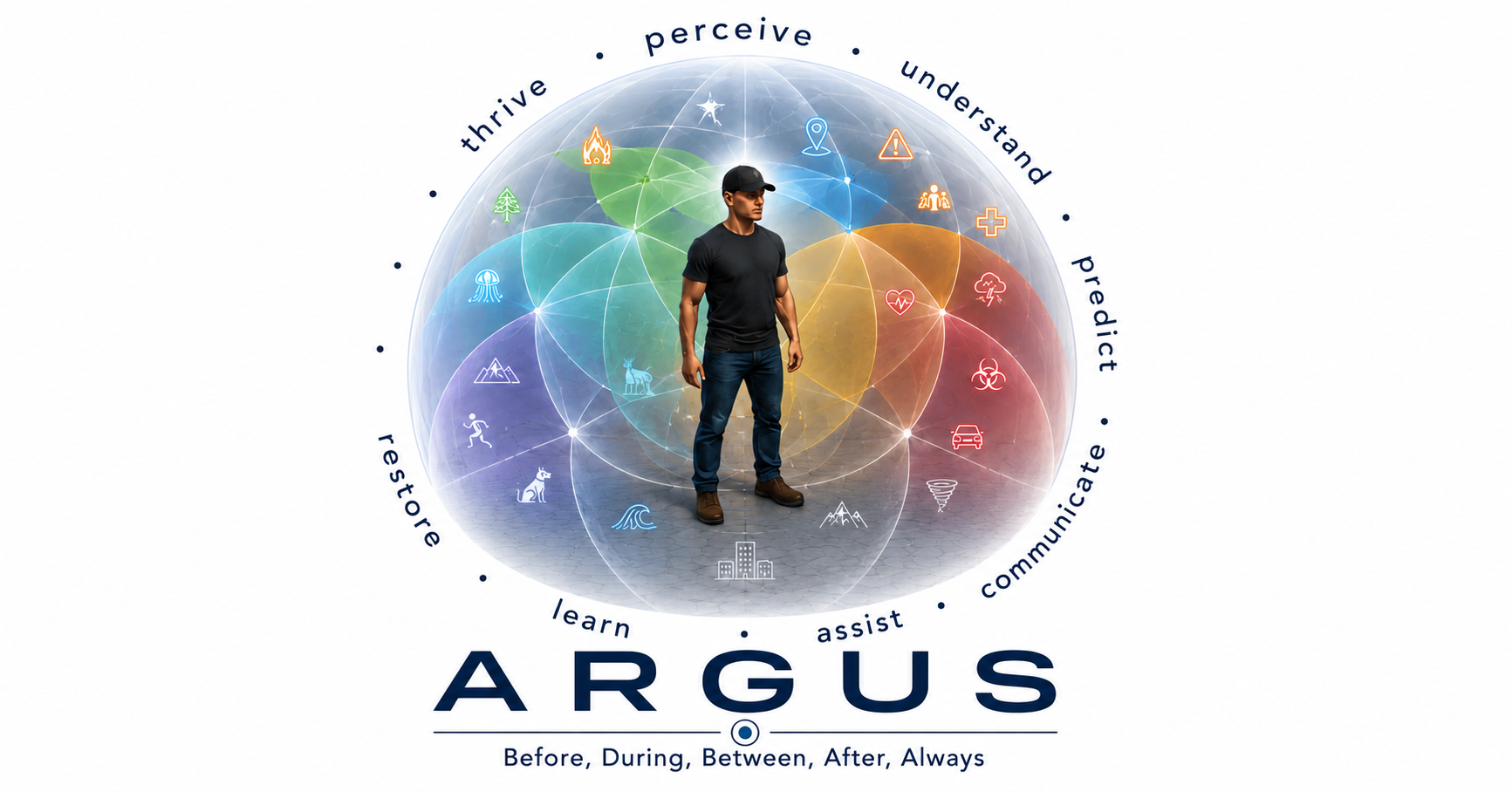
ARGUS brings those questions into a recursive, human-centered architecture: anticipate developing conditions, avoid danger where possible, defuse encounters where appropriate, and support necessary protection when forced—while continuing to reassess the human, the world and the mission.
The full approach connects preparation, uncertainty, guidance, protection and recovery, with its evidence and remaining engineering questions made explicit.
Protection begins while choices remain
Consider someone walking toward a familiar destination. A person behind them appears to be following. There may be an innocent explanation. A nearby business is open, the entrance is reachable, and entering it would give the walker company, light and a chance to reassess. That modest change may be useful before anyone can establish intent. Waiting for certainty can consume the very options that would make the situation easier to manage.
The useful question is what help is justified now, for this person, with these surroundings and this amount of time. A person who moves slowly, relies on a support aid or is responsible for a child has different practical options from an unencumbered runner. The same observation can therefore have different consequences without becoming proof that anyone intends harm.
ARGUS treats preserved options as a design objective. Preparation, observation and timely guidance should help a person carry out a mission, or change it appropriately, and return safely. Ordinary improvements made early deserve as much engineering attention as urgent warnings.
The human and the mission stay in the picture
The proposed architecture follows the human, the world and the mission together. A change in the world can alter the person’s options. Fatigue or an injury can alter what an otherwise open route means. A change in the mission can make a previously sensible action unnecessary. These relationships continue across several time horizons, from an immediate encounter to the remainder of a journey.
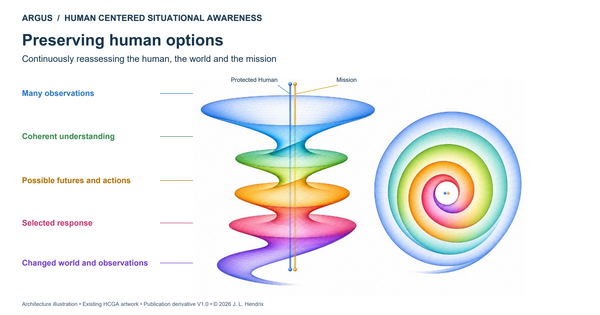
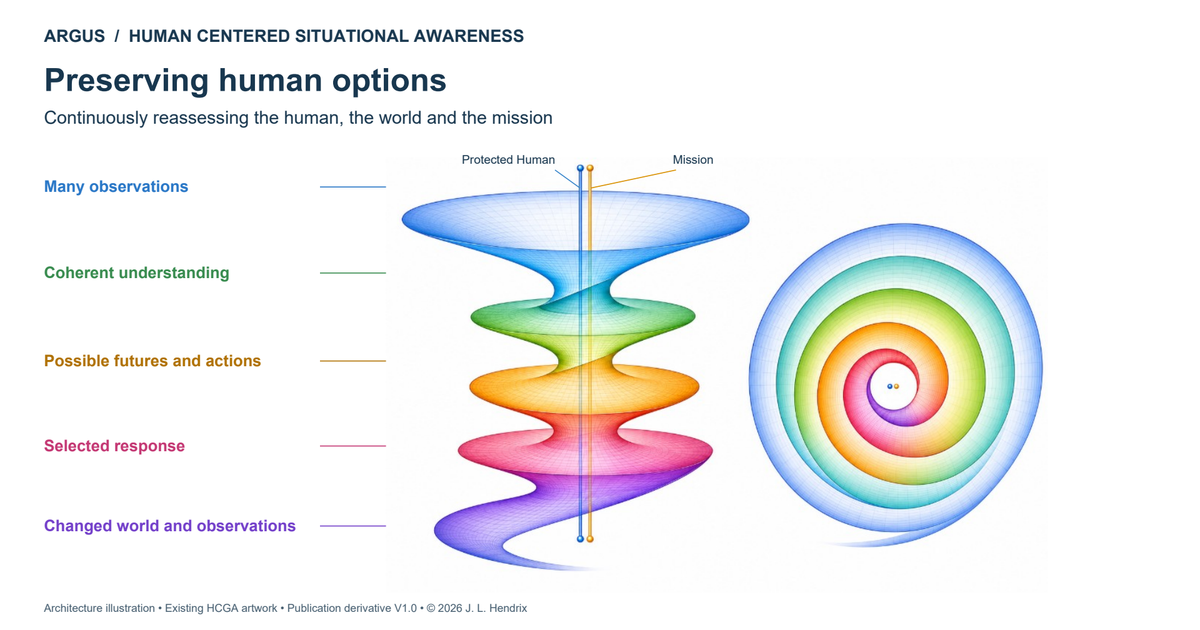
The colored helix illustrates that continuing relationship. Many observations contribute to coherent understanding; possible futures and actions inform a selected response; the changed world supplies new observations. The Protected Human and the Mission remain continuous references through that reasoning.
Recursion allows any relevant result to reopen an earlier judgment or redirect later work. A newly observed barrier may require a new route and a new estimate of available time. An attempted action may reveal that the person cannot use the suggested movement. Neither observation should have to wait for a rigid sequence of stages to finish.
Uncertainty must support useful judgment
An observation, a report, a prediction and an assumption have different meanings. A predicted position is not a fresh sighting. Several copies of one report do not provide independent confirmation. A system should preserve those distinctions while deciding what assistance the evidence can support.
Useful caution also has consequences. A warning may distract, and an unsupported movement instruction may increase exposure. Withholding useful help may allow a closing hazard to consume the remaining response window. Evaluation must account for both kinds of failure. An unmeasured cost of silence cannot simply be entered as zero.
Where time allows, guidance can explain options and their limitations. When justified protection must be immediate, a concise cue may be appropriate. Its direction and meaning still need to fit the person and the surroundings. A correct message delivered after the person can act is not timely protection.
Preparation must match present capability
Experienced practitioner knowledge contributes mechanisms, alternatives and recognition of failure. It belongs in the design work. Historical experience alone does not establish what an individual can do today, and a generic label such as “trained” cannot stand in for a feasible prepared response.
Significant physical disadvantage changes urgency and the consequences of delay. A person may be unable to withstand a first blow or create separation through speed or strength. The architecture must not require dialogue, injury or a sequence of failed weaker responses before recognizing a need for immediate protection. It must also preserve the person’s independent judgment and action; ARGUS permission is not a prerequisite.
Prepared options need current functional fit, a realistic starting position and a way to respond when the first attempt fails. A dependent’s protection introduces additional tasks. Calling for help can be essential while still leaving an immediate protective task uncovered.
A completed movement is not a completed encounter
“Stop the threat and no more” requires attention to the continuing attack. A released wrist can be followed by another grip, a strike or pursuit. The success of one movement therefore cannot establish that the person is secure.
Genuine breakoff, an observed inability to continue the immediate assault, or substantial effective separation with a suitable refuge can change the need for defensive force. These conditions require context. A brief pause or a missing camera view does not establish safety. Once the protective need for force ends, that force ends; awareness, assistance and recovery can continue.
The same reasoning applies outside interpersonal danger. Avoiding one falling object does not establish that the overhead hazard has ended. Reaching a shelter does not establish that everyone is accounted for or that the shelter meets the present need. Protection continues through the actual human task.
What the work establishes
This is an architecture and preparation framework. Its present basis combines documented design work, source reviews, authored case analysis and bounded software exercises. It is not a claim that a deployed system can reliably recognize every threat, direct physical defense or guarantee a safe outcome.
The next engineering step is deliberately bounded: demonstrate one ordinary avoidance case and one continuing-attack boundary case, including a benign situation in which no interruption is useful. Measure the age of the observations, the delivery and interpretation of cues, and the continuing availability of the person’s options. Preserve uncovered tasks and failed cases alongside successful checks.
The public reference edition develops the approach across sensing, understanding, forward branching, preparation, guidance, protection and recovery. It also identifies the evidence still needed. We invite informed technical discussion about how to make that coordinated assistance useful to the person who must live with its consequences.
Read the public reference edition
© 2026 J. L. Hendrix. All rights reserved.