When Is Well-Supported Research Ready to Guide a Real Decision?

What must we establish before research becomes a sound basis for action? Is evidence that a finding holds under studied conditions sufficient, or must we also explain why it applies to the person and circumstances before us?
Our starting proposal is that useful guidance requires both an assessment of the evidence and an assessment of its present applicability. Those judgments must remain open to revision as new observations arrive.
In the first installment, we examined the transitions between information, interpretation, judgment, and action. Research offers a useful place to examine one of those transitions more closely: how a supported finding becomes advice.
How research earns confidence
Experimental and observational research makes claims available for examination through descriptions of methods, evidence, analysis, and limitations. The details matter because they allow others to question how a conclusion was reached.
Research also develops and tests theories that shape which questions are asked, which observations are collected, and how results are interpreted. That relationship deserves a separate examination—including how our own proposed framework could favor an explanation it should reconsider. Here, we focus on the passage from a research finding to guidance for a particular person.
Peer review contributes to that examination. For example, PLOS One’s publication criteria address technical soundness, appropriate analysis, sufficient methodological detail, and whether the data support the conclusions. These are substantive checks on a manuscript’s reasoning and reporting. PLOS One publication criteria
Further checks ask different questions. Can an analysis produce consistent results when repeated with the same data and methods? Do studies collecting their own data obtain consistent findings? How far do those findings extend beyond the original setting?
The National Academies distinguishes these questions through reproducibility, replicability, and generalizability. Establishing one does not automatically establish the others. Reproducibility and Replicability in Science
This distinction gives us a more useful vocabulary than a single label such as “validated.”
Where does the finding apply?
Research already addresses applicability through study design, examination of differences among populations and settings, and investigation of the conditions under which results hold. Generalizability is part of scientific inquiry itself. National Academies
Our question concerns what happens when a finding leaves that research context and enters a particular decision.
Consider a hypothetical study comparing two ways of presenting navigation instructions. Participants complete a controlled walking task, and one method produces fewer wrong turns.
Suppose the methods are sound, the analysis can be reproduced, and independent studies obtain similar findings. We have reasons to take the result seriously.
Now imagine using it to guide someone through an unfamiliar station. The person is carrying luggage, has difficulty hearing, and encounters an unexpectedly closed passage.
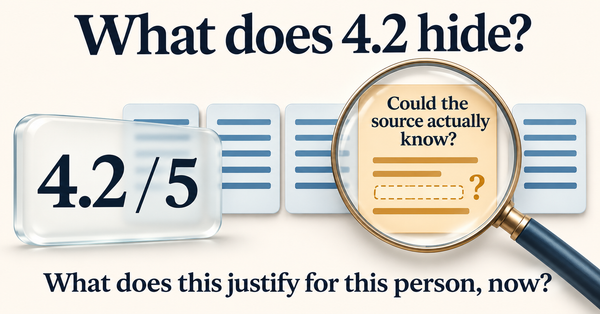
What exactly does the research justify here?
It may support a preference for one presentation method within the conditions examined. It does not, by itself, establish that a particular instruction is accessible to this person, that the route remains available, or that the person understood the message.
Those are additional questions requiring evidence from the present situation.
What should accompany a finding?
A conclusion can become difficult to use responsibly when separated from the conditions that support it.
For the framework we are developing, we propose preserving a finding alongside its sources, methods, limitations, applicable conditions, unresolved questions, and evidence that would justify reconsideration.
That record would support a continuing comparison: which relevant conditions still hold, which have changed, and which remain unknown?
A mismatch would need investigation. The research might have limited applicability. The current observation might be unreliable. The system might have interpreted either one incorrectly.
In our hypothetical station, the closed passage should prompt reconsideration of the route. It need not undermine the research on how instructions are presented. Preserving that distinction helps us revise the appropriate judgment.
What would justify guidance now?
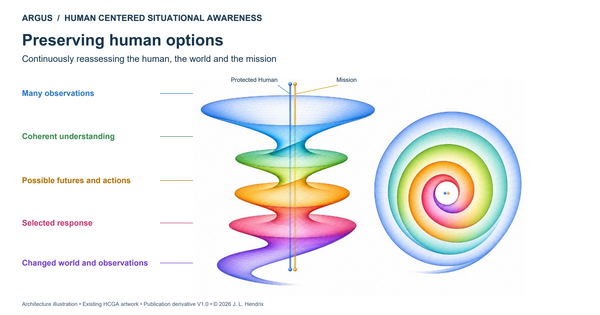
For ARGUS, these questions have a practical purpose: helping a person understand changing circumstances while preserving useful choices. The framework remains a proposal to develop and test.
What evidence should accompany a finding before it becomes guidance?
How should we distinguish confidence in the research from confidence in its application to this person?
When observations conflict with expectations, what would help us identify which assumption needs revision?
And when time limits prevent further investigation, how should guidance explain its uncertainty and preserve the person’s ability to choose?
When, then, is well-supported research ready to guide a real decision—and what must we continue observing after it does?